
IKN's Giant Screen vs. My Poo Fighter: Monitor vs. Act
Visited IKN this week as IBM Indonesia is part of a USTDA-funded smart city initiative supporting Otorita IKN, and I was there as part of that engagement, talking about IBM Bob. Got a peek inside the Nusantara Command Center (the ICCC, Integrated Command and Control Center). The screen is huge. Tipinya gedhe banget..
Walking in there was a sign saying no photos. Noted. Toured the room, took it all in. Then at the end the staff offered to take a group photo in front of the wall. So apparently that was fine. The wall behind us had: traffic intersection dashboards with live CCTV feeds and queue length graphs, vehicle speed and density readouts, signal phase timers, fleet GPS positions on a map, a national fire hotspot heatmap, solar field power curves, network telemetry. All of it live, all of it filling most of the wall. Impressive as a piece of engineering. Impressive as a statement of intent. Someone clearly had a budget.
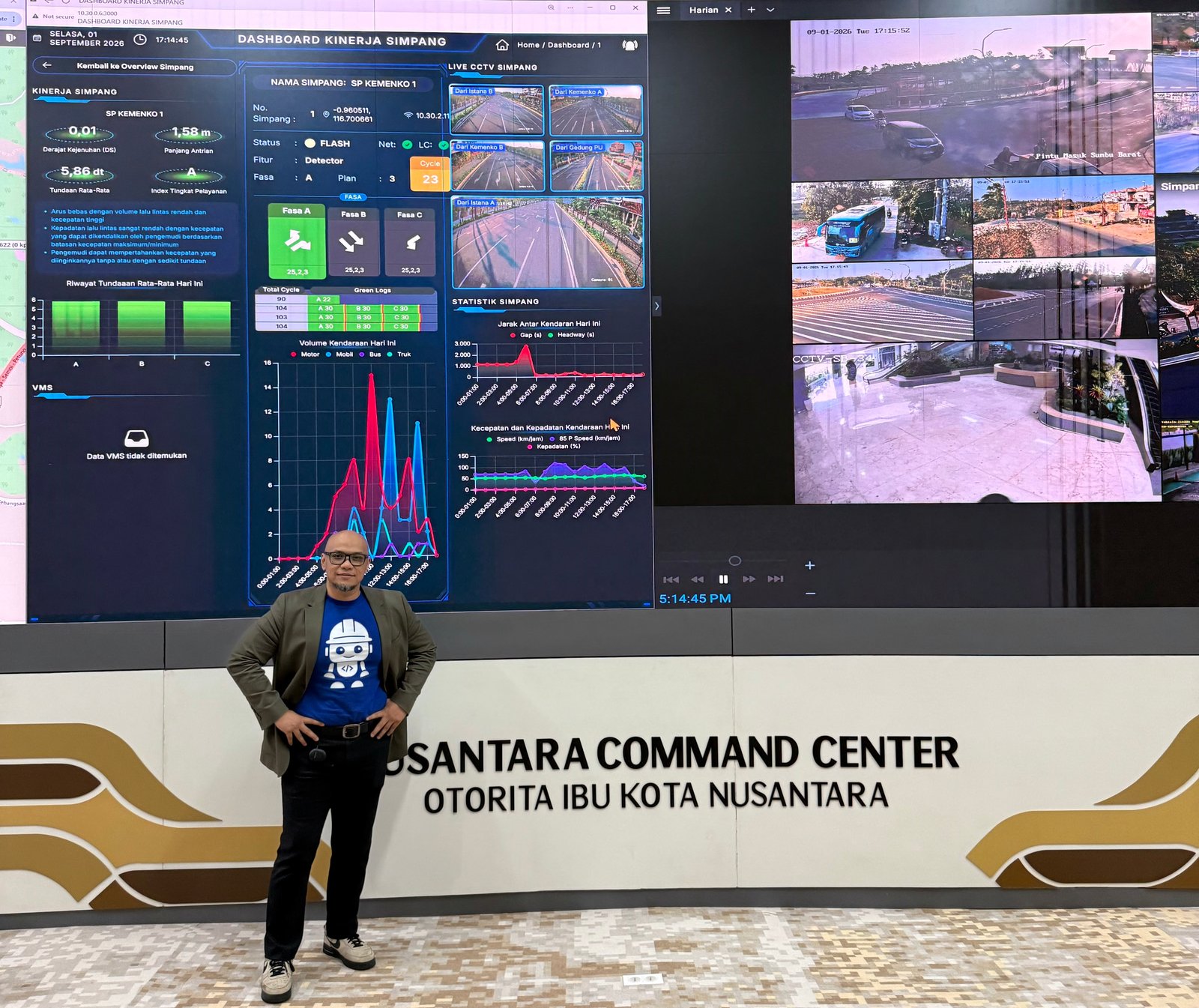
But standing there I kept thinking about my porch.
The poo-fighter framing
Back home I have a seasonal civet problem, when the neighbourhood mango tree fruits and they come looking. They cross my rear canopy at night. My poo-fighter setup is Home Assistant + Frigate + a Coral Edge TPU + one floodlight wired to a relay. It catches the silhouette, fires the light, and the civet runs. No human in the loop. Nobody watching a screen at 2am. The monitoring and the action are collapsed into one automated flow.
My “command center” is a tablet on the TV table. Most of the time the most important thing on it is how much energy the solar panels are generating, and who’s at the front gate which is mostly e-commerce deliveries.
The IKN ICCC is the opposite model. Beautiful, expensive, centralised visibility. And then humans watching it, deciding what to do next. Looking back at what was on those screens, every panel was passive monitoring or supervisory telemetry. The intersection dashboard (“Dashboard Kinerja Simpang”) shows queue lengths, speed indicators, and level-of-service grades with no autonomous signal adjustments. The alert cards use threshold badges (green, yellow, red) to flag events for operators. The fleet map shows GPS coordinates and speeds of numbered units, not autonomous dispatch.
The fire heatmap deserves a specific call-out. Those yellow, orange, and deep red zones are Karhutla - kebakaran hutan dan lahan, forest and land fire - hotspot monitoring pulled from NASA Terra/Aqua, SNPP, and NOAA-20 satellite passes via SiPongi (Kementerian Kehutanan). I was there in early September, which is peak dry season. At that point SiPongi was logging over 1,370 high-confidence hotspots nationally, the majority concentrated across West and Central Kalimantan - exactly the dense red-banded zones filling that screen. The map covered all of Indonesia, not just Kalimantan - hotspots across Sumatra too, consistent with SiPongi’s national view. Six provinces were already under active Kemenhut/BNPB aerial firefighting operations.
SiPongi is not purely a display system though. It has operational dispatch integration - verified hotspot coordinates pushed directly to Manggala Agni ground brigades, BPBD regional agencies, and joint military/police task forces for ground verification and aerial water-bombing deployment. The Fire Danger Rating System maps that appear on screen (the colour gradient overlays) are generated from live weather, soil moisture, and drought index data. So somewhere in the SiPongi backend, this data is already feeding action.
Whether the ICCC’s rendering of that feed is hooked into the same dispatch workflow, or is just pulling the visualisation layer - I couldn’t tell from the visit. IKN sits in East Kalimantan and transboundary haze from West and Central Kalimantan is a direct proximity risk to the capital, so there’s obvious local relevance. But the honest answer is: for this panel specifically, the action layer may already exist upstream in SiPongi. The ICCC screen might just be a window into a system that already does close the loop.
None of it was driving automated action. All of it was feeding human eyes.
Two different answers to the same question
Both setups are trying to answer: something is happening, what do we do about it?
My poo-fighter answer: detect → act autonomously, no delay, no operator needed.
The ICCC answer: detect → display → human observes → human decides → (hopefully) someone acts.
The ICCC model makes sense at city scale where the action is complex: rerouting traffic, dispatching emergency services, coordinating across agencies. You can’t fully automate that. The human judgement layer is the point.
But I keep coming back to this: how much of what’s on that big screen actually feeds into a decision, versus just being visible?
Monitoring vs. acting: the real gap
A screen full of real-time data is not the same as a system that acts on real-time data. The gap between the two is where most smart-city projects quietly stall.
The impressive part of IKN’s ICCC is not the screen. It is whether there are feedback loops behind it: automated signal adjustments, escalation workflows, SLA timers that fire when a metric crosses a threshold. Based on what’s visible, there are none. The alert cards flag events; a human has to see that flag and decide to act. The fleet map shows where vehicles are; a human has to call a driver. The intersection dashboard grades performance; a human has to phone the traffic control unit.
That’s not a criticism of the people who built it. Standing up centralised telemetry across a new city’s worth of sensors is genuinely hard work. But the screen is doing the work, and the action layer doesn’t appear to exist yet.
My poo-fighter has a tight feedback loop: detect, act, done. It doesn’t need a screen at all. I added the Home Assistant UI because it’s handy, not because it’s necessary.
The IKN ICCC needs the screen because the actions are genuinely complex and need human coordination. But the screen alone is not the system.
This is where agentic AI starts to look relevant. Not replacing the operators, but closing some of those loops autonomously within defined scope. The poo-fighter is a primitive agent: it detects a condition, evaluates it against a rule, fires an action. No human needed. That works because the problem is narrow, the stakes are low (worst case, the civet gets away), and the action is reversible.
City-scale is harder. An agent that autonomously re-times a traffic signal when queue length crosses a threshold is straightforward. An agent that dispatches a water bomber based on a SiPongi hotspot confidence score is a different conversation entirely - though Indonesia would need to have water bombers first, which is a separate problem all together. The scope has to be defined. The governance has to be there. And for anything with meaningful consequences, human-in-the-loop isn’t a weakness of the design, it’s the point.
What I’d want to see behind a screen like the ICCC’s is not just dashboards, but agents with clearly bounded authority: act here automatically, escalate here to a human, never act here without sign-off. The screen then becomes an audit trail of what the agents did and what they kicked upstairs, rather than a passive feed waiting for someone to notice something.
That’s the architecture worth building toward. At enterprise scale, something like watsonx.orchestrate or LangFlow can wire this up - agents with defined tools, escalation paths, and audit trails.
Early ideation, not a verdict
I’m not saying the ICCC is wrong. I don’t know the full architecture behind it, and city-scale coordination is a genuinely different problem from chasing civets off a porch. This is me thinking out loud after standing in that room.
For any monitoring system the question is not “how big is the screen” or even “how fresh is the data.” It’s “what happens next, and how fast, and does a human need to be in that loop?”
For civets: no. For intersection signal timing at 3am with zero traffic: probably also no. For a multi-agency incident response at peak hour: yes.
The spectrum between full autonomy and full human-in-the-loop is where the real design work lives. The big screen is just the most visible artifact of one point on that spectrum.
